
If you are unable to visit our gallery and would like to purchase photographs from this preview or others in the gallery, please contact the gallery and call 585-271-2540.
Gallery Picks of the Show
Women's Perspectives 2026
April 21 - May 17, 2026
Gallery
Partners have chosen our "Picks of the Show"
by Guest
Photographers
All images copyright by the individual photographers
Sunlight and Six Strings When I first saw Steve Dent’s photo called
Sunlight and Six Strings, I wondered: Is the photo about the
act of playing music – or about being free on a summer day? It
brought me back to my teen years during the 60’s, and I was reminded
of the spirit of the folk era. I recalled moments in backyards and
on hillsides where friends gathered to play music and listen. For me the title suggests a kind of harmony:
sunlight as the visual “music,” and the guitar as the audible
counterpart. Together, they create a sensory pairing–light and
sound–blending into a single expressive moment.
Sunlight suggests openness, warmth and natural simplicity–an
outdoor, unguarded existence. The six strings (guitar) anchor it in
music. The title feels less like a literal description and more like
a mood created by sunlight, music and freedom.
Steve’s mastery of portraiture is evident in the way he balances
intimacy and atmosphere, allowing the viewer to sense both the
presence of the musician and the unseen melody that surrounds her.
The moment captured is less about observation and more about
connection–between the artist and instrument, light and form, and
ultimately image and viewer.
What do you feel when you look at this photo?
Congratulations, Steve, for your Gallery Pick!
By Marie Costanza
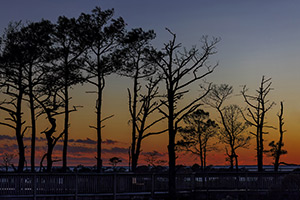
Island Sunset
Island
Sunset
by Joyce Freitas is a striking study in contrast and atmosphere. The
photograph uses colors of a bold sunset palette to reduce the
landscape to essential forms, turning ordinary elements into a
quietly dramatic scene. Its clarity of vision and restraint make the
image feel both immediate and timeless. Strong
sunset color dominates the frame, bathing the sky in saturated hues
that push the trees into near-black silhouettes. The intense
backlight simplifies detail and emphasizes outline, so trunks and
branches read as graphic marks against the glowing sky. This
reduction heightens the photograph’s visual impact and gives it a
cinematic stillness. Symmetry
of the trees creates an almost architectural presence—a linear wall
that separates foreground from the distant horizon. The repeated
verticals form a rhythmic barrier that organizes the composition and
lends a sense of order. That wall-like quality makes the scene feel
deliberate and composed, as if the trees are guardians of the
shoreline. A glimpse
of water and clouds beyond the tree line provides just enough
context to suggest place without distracting from the main motif.
The narrow band of reflective water and the soft shapes of clouds
anchor the composition and offer a subtle counterpoint to the dense
silhouette, reminding the viewer of depth and distance. Some of
trees fully leafed, others bare which adds a quietly poignant layer
to the image. The mix of life and bareness introduces texture and
narrative: cycles of change, resilience, and quiet decay. That
contrast prevents the symmetry from feeling static and invites
closer inspection.
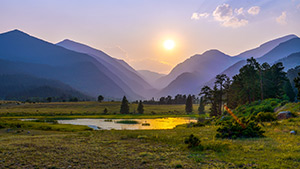
Sheep Lake Congratulations to Tom Knauss, whose photo
Sheep Lake, taken in Rocky Mountain National Park,
shows how he captured a moment where light and atmosphere
transformed a familiar scene into something serene. Sunsets are
often a popular subject of photographers, but what makes this one
memorable is how the setting sun settles into layered mountain
ridges; each receding plane softening into shades of violet and
blue, creating a sense of depth and distance. The reflective surface
of Sheep Lake becomes a golden anchor, drawing the eye into the
scene and echoing the warmth of the sky.
A particularly compelling aspect of Tom’s photo is the balance that
exists between warmth and coolness, stillness and movement,
simplicity and richness. The silhouetted trees at the edge provide
just enough grounding to contrast the expansive openness beyond.
Some photos tell an obvious story, but what I appreciate about Tom’s
photo is that it opens a door for viewers to bring their own
memories or sense of peace into the photo. For me the story is about
the tranquility of the setting and how pleasant it would be to just
sit there and take in the quiet beauty all around as the day winds
down. By Marie Costanza
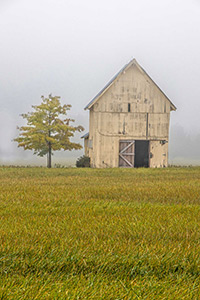
Tribute to Geneseo Yellow Barn Congratulations to Donna LaPlante for her
marvelously evocative photo Tribute to Geneseo Yellow Barn.
Beginning with a quiet, contemplative presence, Donna captures the
rural landscape with clarity and grace. The composition is simple
yet effective: the barn, placed slightly right of center, is
balanced by the lone tree on the left. This creates a natural flow
for the eye, while the open field and soft, foggy background give
the scene space to breathe. Her color
is gentle and unified. The warm yellow of the barn echoes the autumn
tones in the tree, while the greens of the field provide a calm
foundation. Nothing feels overpowering; instead, the colors work
together to suggest a moment of seasonal change. The soft
light and fog smooth out contrast and create quiet transitions
between tones, allowing details—like the weathered wood of the
barn—to emerge with subtle texture and a sense of history. The tall
grass in the foreground adds depth, gently drawing the viewer into
the scene before the eye settles on the barn and tree. There’s a
strong feeling of stillness and solitude. The partially open barn
door introduces a hint of narrative, inviting curiosity about what
lies within or what has just passed. Overall, the photograph
encourages viewers to pause, reflect, and appreciate the quiet
beauty of an everyday moment. Thank
you, Donna, for a quiet, contemplative reflection of this time and
space. By Dick Bennett
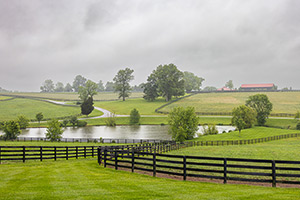
Misty Morning in Horse Country
This is a quietly disciplined landscape, especially in structure and
mood.
Its biggest strength is composition through repetition and flow. The
black fences create a beautiful rhythm, almost like contour lines on
a map. They guide the eye naturally from foreground to midground and
then out toward the horizon. That winding road reinforces this
movement, giving the image a gentle sense of journey.
There’s also a solid use of layering: foreground grass → pond →
middle fields → distant barns. This creates depth without needing
dramatic lighting.
The overcast atmosphere works conceptually. The soft haze flattens
contrast and gives the scene a calm, pastoral stillness. It feels
quiet and orderly.
Martha is a photographer with a good eye for structure and calm
compositions. It’s aesthetically pleasing and technically sound.
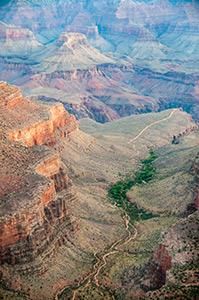
Bright Angel Trail and Havasupi Gardens
This is a strong landscape image especially in how it balances
scale, color, and visual flow.
The biggest strength is the sense of depth. The layered formations
receding into atmospheric haze create a beautiful compression of
space. That soft bluish fade in the distance contrasts nicely with
the warmer foreground cliffs, which is classic and effective for a
place like Grand Canyon.
The leading line is excellent. The winding trail and the green
ribbon of vegetation pull your eye from the bottom of the frame deep
into the scene. That path gives the viewer a way to “enter” the
image, which is essential in expansive landscapes like this.
Color-wise, the image leans slightly pastel, which gives it
a dreamlike feel. That’s a stylistic choice, and here it works. It
softens the harshness that canyon scenes can sometimes have.
Mike has created a thoughtful, well-composed photograph with strong
spatial depth and a pleasing color palette. It leans more
toward quiet, contemplative landscape than dramatic spectacle. This
is a valid and effective direction. By Don Menges
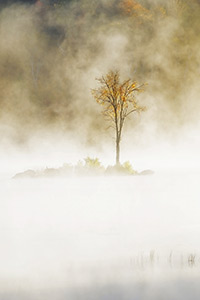
The Lonely Sentinel
Patty Singer’s The Lonely Sentinel is a quietly powerful
photograph that speaks through restraint. The image relies on a
single, carefully placed subject and generous empty space to create
an immediate emotional charge. Its confidence comes from what it
omits as much as from what it shows.
Minimalistic composition
is the photograph’s strongest asset. A solitary tree occupies the
frame with deliberate economy, allowing negative space to become an
active element. The sparse arrangement sharpens focus on form and
silhouette, turning the tree into a visual and emotional anchor.
Muted colors and areas of no color
give the scene a meditative calm. A subdued palette reduces
distraction and heightens texture and line. Where color fades into
near absence, the photograph gains a timeless, almost graphic
quality that emphasizes shape over detail.
Symbolism of the lonely tree landscape
is rendered with subtlety rather than sentiment. The lone tree reads
as a sentinel—steadfast, watchful, and quietly resilient—inviting
reflections on solitude, endurance, and the passage of time. The
emptiness around it amplifies those themes without tipping into
melodrama.
Balance provided by the grasses in the lower right corner
is a masterful compositional touch. Those grasses counterweigh the
tree, introduce a gentle diagonal, and give the eye a place to rest.
Their texture and placement create a visual dialogue between
foreground and subject that stabilizes the whole image.
The Lonely Sentinel
is an exercise in photographic restraint that rewards slow looking.
Patty Singer transforms simplicity into narrative, using minimal
elements to evoke a rich emotional landscape. The result is a
photograph that lingers—quiet, composed, and deeply assured.

By Steve Dent
by Joyce Freitas
By Tom Knauss
by Donna
LaPlante
By Martha Price
By Michael Shoemaker
by Patty Singer
Image City Photography Gallery ♦ 722 University Avenue ♦ Rochester, NY 14607 ♦ 585.271.2540
In the heart of ARTWalk in the Neighborhood of the Arts